Paris, France – August 2026 – LabCollector, the leading laboratory information management platform, today announced new ELN Consortium-compatible import and export capabilities within its Electronic Lab Notebook (ELN) module. The new functionality is built on the ELN Consortium archive format (.eln, based on RO-Crate 1.1), the recognized open standard for portable research data.
The new capabilities enable laboratories to exchange notebook content across compatible ELN platforms, improving interoperability and facilitating data migration. Researchers can import archives into new or existing LabCollector books with just a few clicks, while the export side allows LabCollector notebooks to be shared outward to other ELN Consortium-compatible systems.
As the scientific community increasingly demands open, vendor-neutral formats for research data, this development reinforces LabCollector's commitment to open standards, data portability, and collaborative scientific research.
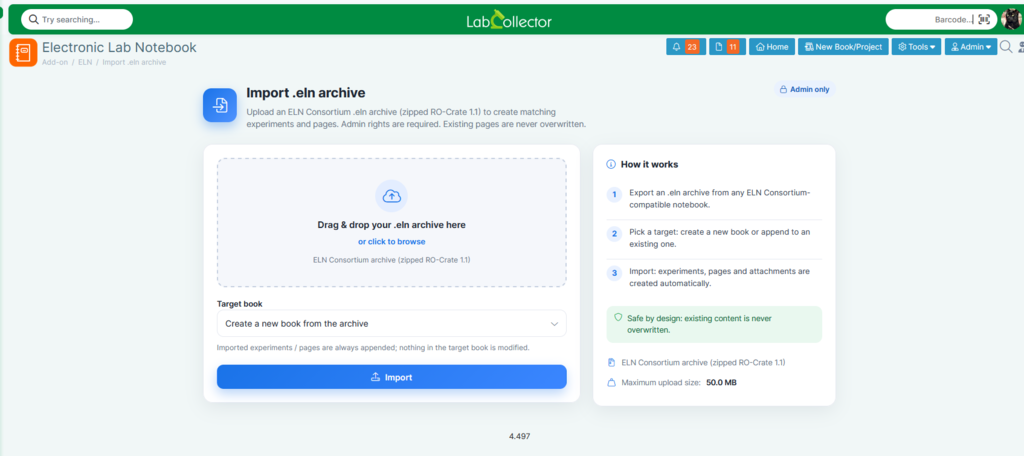
How It Works
The import process is designed to be simple, safe, and faithful to the original notebook structure. It follows three straightforward steps:
- 1
Export an .eln archive
Export an .eln archive from any ELN Consortium-compatible notebook — a zipped RO-Crate 1.1 bundle of experiments, pages, and attachments.
- 2
Pick a target book
Choose to create a new book from the archive or append to an existing LabCollector book. Nothing in the target book is modified.
- 3
Import in a few clicks
Import: experiments, pages, and attachments are recreated automatically inside LabCollector, preserving structure and metadata.
The import process automatically recreates experiments, pages, and attachments while ensuring that existing content remains untouched. Archives up to 50 MB can be uploaded, and admin rights are required to perform an import — keeping notebook integrity and governance in the right hands.
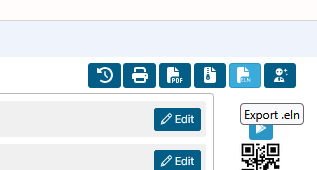
On the export side, the same standard is available directly from the ELN action bar. A single click on the Export .eln button packages the current book — its experiments, pages, and attachments — into a portable .eln archive that can be opened by any ELN Consortium-compatible notebook, making sharing and migration symmetric and bidirectional.
Key Benefits
The new .eln import and export capabilities deliver several key advantages:
Open standards
Built on the ELN Consortium .eln format and RO-Crate 1.1, the recognized open standard for portable research data.
Cross-platform interoperability
Exchange notebook content between LabCollector and other ELN Consortium-compatible platforms without lock-in.
Safe by design
Existing content is never overwritten — imported experiments and pages are always appended to the target book.
Effortless migration
Recreate experiments, pages, and attachments automatically, preserving structure and metadata across systems.
Admin-controlled
Import requires admin rights, keeping notebook integrity and governance in the right hands.
Attachments preserved
Files and attachments travel with the archive, so context is never lost during migration.
"Open standards are the foundation of trustworthy, collaborative science. By embracing the ELN Consortium .eln format, LabCollector ensures that laboratory knowledge never gets locked inside a single platform — researchers can move their notebook content in and out of LabCollector freely, safely, and without losing structure or context. This is interoperability by design."
A Commitment to Open Standards
The ELN Consortium .eln format is a community-driven, open specification built on RO-Crate 1.1, a structured way to package research objects with their metadata so they can be understood across systems. By supporting the format on both import and export, LabCollector joins a broader movement toward vendor-neutral research data — where notebooks can be shared between institutions, collaborators, and platforms without proprietary conversion or data loss.
This matters most in collaborative and multi-site research, in migrations away from legacy or end-of-life ELNs, and in any context where long-term data portability and reproducibility are required.
Who Benefits
The new capabilities are particularly valuable for organizations that need to exchange or migrate notebook content across platforms and partners:
Availability
ELN Consortium-compatible .eln import and export is now available within the LabCollector Electronic Lab Notebook module. Laboratories interested in learning more about the latest LabCollector ELN features and how open standards are shaping the future of research data management can request a demonstration or contact the LabCollector team.
About LabCollector
LabCollector is a comprehensive laboratory management platform that helps research and industrial laboratories organize samples, inventories, equipment, protocols, experiments, and purchasing activities within a unified environment. Used by laboratories worldwide, LabCollector improves efficiency, traceability, collaboration, and compliance across LIMS, ELN, and lab operations.
About the ELN Consortium
The ELN Consortium is a community initiative promoting open, interoperable formats for electronic laboratory notebooks. Its .eln archive format, based on RO-Crate 1.1, packages experiments, pages, and attachments into a portable, self-describing bundle that can be exchanged between compatible ELN platforms.
 English
 French
 Spanish
 Portuguese
 Italian
 Polish
 German
 Dutch
Dutch Danish
 Swedish
 Greek
Greek Norwegian
 Finnish
 Romanian
 Hungarian
 Czech
Czech Slovak
 Hebrew
 Arabic
 Japanese
 Korean
 Ukrainian
 Latvian
 Turkish
 Croatian
 Chinese (Simplified)
 Bulgarian