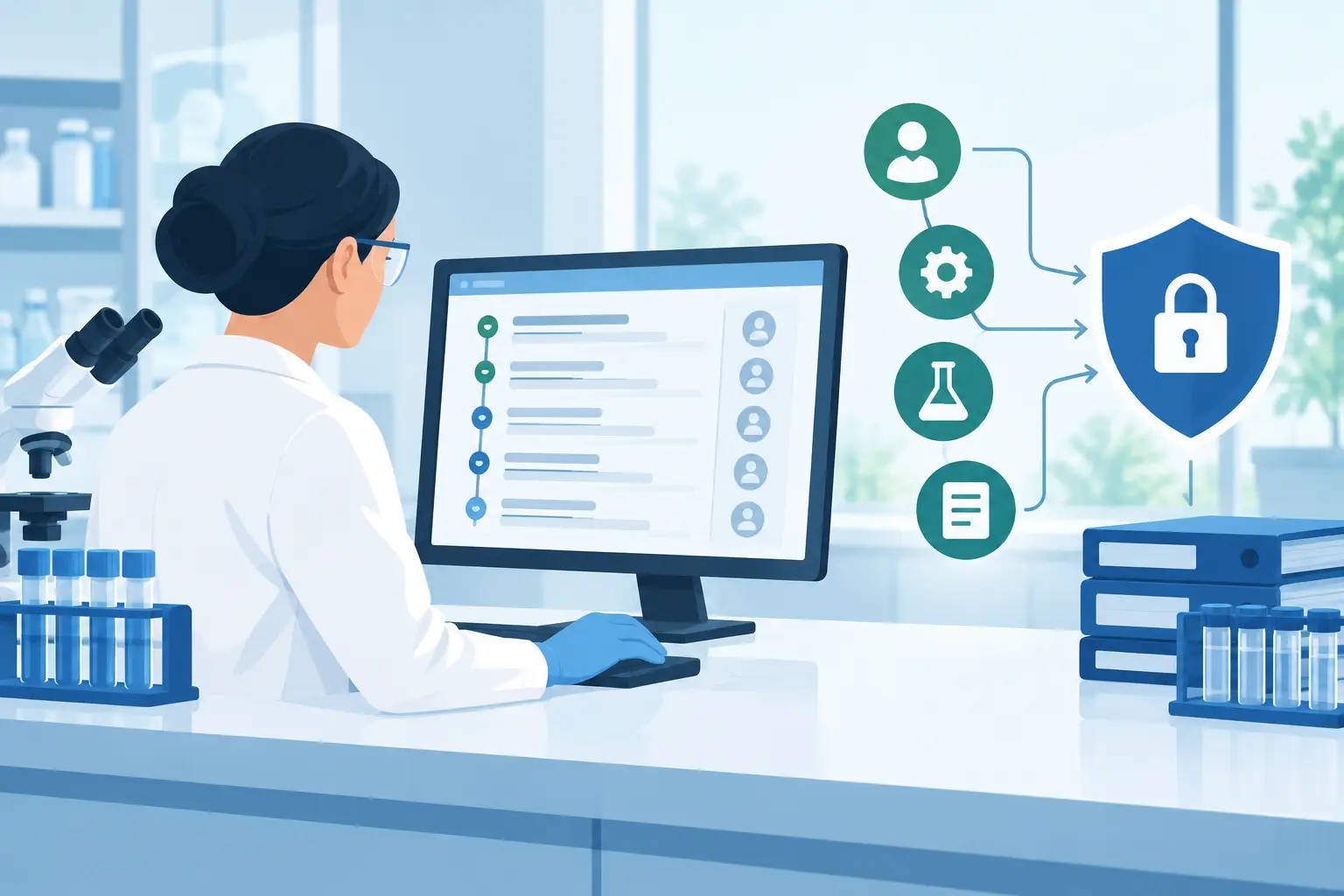
A sample result changes after a quality review. A reagent lot is corrected after the assay is complete. An instrument file is replaced because the original export was incomplete. In each case, the question is not simply whether the laboratory has the current record. The question is whether it can reconstruct what happened, who acted, why the change occurred, and whether the decision was appropriate. Creating laboratory audit trails is the operational discipline that makes those answers available when they matter.
For research, clinical, quality-controlled, and regulated laboratories, an audit trail is more than a technical record generated by software. It is evidence that the laboratory controlled its data and workflows. When designed well, it supports data integrity, investigation readiness, reproducibility, internal review, and efficient operations. When designed poorly, it creates large volumes of disconnected system activity that are difficult to interpret and even harder to review.
An audit trail is not just an activity log
An activity log may record that a user opened a sample record at 10:14 a.m. That can be useful, but it does not necessarily establish data integrity. A meaningful audit trail focuses on events that affect the identity, status, value, interpretation, or disposition of laboratory data.
For example, a trail for a sample should show when it was registered, how it was labeled, where it was stored, when its status changed, and who authorized a disposal or transfer. For an experimental record, it should preserve entries, revisions, attachments, approvals, and any changes to calculated or reported results. For inventory, it should document receipt, lot assignment, expiration updates, consumption, and corrections.
The practical standard is simple: a reviewer should be able to understand the before state, the after state, the responsible user, the date and time, and the reason for a consequential change. If a record cannot provide this context without relying on memory, email threads, or paper notes, the audit trail is incomplete.
Start by defining which events require traceability
Not every click requires the same level of control. Capturing every low-risk interaction can bury critical events in noise, increase review time, and make exception detection less effective. The right approach is risk-based: identify the records and actions that could affect scientific conclusions, patient-related information, product quality, compliance status, or operational accountability.
Begin with a workflow map. Follow a sample, material, or result from intake through storage, processing, analysis, review, reporting, and retention. At each step, identify where a user can create, modify, approve, invalidate, transfer, or delete information. These are the likely control points for an audit trail.
Focus on high-impact record changes
Laboratories commonly need detailed audit coverage for changes to sample identifiers, parent-child relationships, test assignments, storage locations, chain-of-custody events, result values, specifications, instrument-generated data, reagent lots, expiration dates, and equipment status. Approval workflows and electronic signatures also require clear records because they demonstrate who reviewed a decision and under what authority.
It depends on the laboratory's operating model. A discovery research group may prioritize experiment versions, sample provenance, and material use. A clinical or regulated laboratory may need stronger controls over result amendments, reason-for-change fields, review status, and access privileges. The underlying principle remains the same: audit the events that could materially change the meaning or reliability of a record.
Define the minimum information for each audit event
A timestamp alone does not explain a change. Every auditable event should carry enough context for an independent reviewer to reconstruct the action without contacting the original user.
For consequential changes, the audit trail should capture at least these elements:
- The unique record affected, such as a sample ID, experiment ID, inventory item, or instrument record.
- The action performed, including creation, modification, status change, approval, transfer, correction, or invalidation.
- The prior and new values when a field is edited.
- The authenticated user identity and the date and time of the event.
- A reason for change when the edit affects controlled data, results, status, or other critical attributes.
Reason fields deserve particular attention. A free-text field that accepts entries such as corrected or updated provides limited value. Configure users to supply a concise but meaningful explanation, such as transcription correction after source review, incorrect reagent lot selected, or result repeated due to failed control. Where suitable, standardized reason categories can improve reporting and trend analysis, while a supplemental comment preserves the necessary context.
Protect audit records from alteration
An audit trail has little value if users can revise or remove it. The application must preserve audit records separately from ordinary data-entry permissions, with controls that prevent routine users from editing, overwriting, or deleting historical events.
This is where role-based access control becomes operationally significant. Analysts may need to enter results but not approve their own work. Lab managers may need to correct metadata but not alter finalized results without a documented amendment process. System administrators may manage configuration but should not be able to make untraceable changes to scientific records. Segregating these responsibilities reduces the risk of accidental or inappropriate changes.
User accounts should be individual, not shared. Shared credentials weaken attribution because a record can no longer be tied to one accountable person. Account provisioning, permission changes, deactivation, password controls, and periodic access reviews should all be governed procedures, not informal administrative tasks.
Electronic signatures can add another layer of control for review, approval, and release events. Their value depends on implementation. A signature should be linked to the exact record version being approved, identify the signer, include the signing date and time, and state the meaning of the signature, such as reviewed, approved, or authorized for release.
Build review into the laboratory workflow
Audit trails are often available but rarely reviewed until an inspection, deviation, or data discrepancy occurs. That approach turns a useful control into a retrospective emergency tool. Routine review should be proportional to the risk of the workflow and the volume of changes.
For high-impact activities, configure review checkpoints at the time of approval. A supervisor reviewing an analytical run, for example, should be able to see changed results, invalidated entries, repeat tests, missing attachments, and relevant comments before finalizing the record. For ongoing operations, exception-based reports can flag events such as repeated sample status reversals, changes after approval, inventory adjustments without a reason, or frequent corrections by a single user.
Reviewers need a usable presentation, not a raw database extract. Chronological ordering, clear before-and-after values, filters by user or record type, and direct access to the affected record reduce review time and improve the chance that anomalies will be recognized. The audit trail should support investigation, not create another spreadsheet that must be manually reconciled.
Connect audit trails across the laboratory system
The most useful audit trails do not stop at one module. A sample movement should connect to its storage location, related experiment, extracted material, instrument run, and resulting data. A reagent lot change should be traceable to the assays and samples affected. An equipment maintenance event should be visible in the context of work performed on that instrument.
Fragmented systems make this difficult. When sample data lives in one application, experiment notes in another, and inventory adjustments in a spreadsheet, reconstructing an event requires manual comparison across sources. That process is slow and introduces interpretation risk.
A centralized LIMS and ELN environment can maintain a consistent identity for samples, materials, experiments, and assets across workflows. In LabCollector, configurable modules for samples, inventory, storage, equipment, documents, and experimental records can be structured around the laboratory's process so that related activity remains connected. The configuration must still reflect defined procedures. Software can record events consistently, but it cannot decide which events are meaningful without a clear workflow design.
Validate the design and maintain it over time
Creating laboratory audit trails is not a one-time configuration task. Test the trail using realistic scenarios before relying on it operationally. Create a sample, change its location, correct an identifier, alter a result, approve the record, and attempt the same action with a restricted role. Confirm that the system records the expected details and that a reviewer can retrieve them efficiently.
Procedures should define when corrections are permitted, which changes require a reason, who may approve amendments, how audit trails are reviewed, and how exceptions are investigated. Train users on the purpose of these controls. Users who understand that a correction is acceptable when documented are less likely to create workarounds outside the system.
As workflows, regulations, instruments, and staff change, revisit the audit design. Additions such as automation, barcode scanning, instrument integration, or new test methods may introduce new data sources and new points where traceability is required. Periodic review keeps the audit trail aligned with actual laboratory practice.
A well-designed audit trail does not make laboratory work slower. It makes each critical action easier to explain, verify, and trust when the laboratory needs evidence most.
See LabCollector on Your Own Workflows
LIMS, ELN, test management, storage and instrument integration on one platform — start free, or have us walk you through it.
Learn more: LabCollector LIMS · Electronic Lab Notebook · Contact · About
 English
 French
 Spanish
 Portuguese
 Italian
 Polish
 German
 Dutch
 Danish
 Swedish
 Greek
 Norwegian
 Finnish
 Romanian
 Hungarian
 Czech
 Slovak
 Hebrew
 Arabic
 Japanese
 Korean
 Ukrainian
 Latvian
 Turkish
 Croatian
 Chinese (Simplified)
 Bulgarian