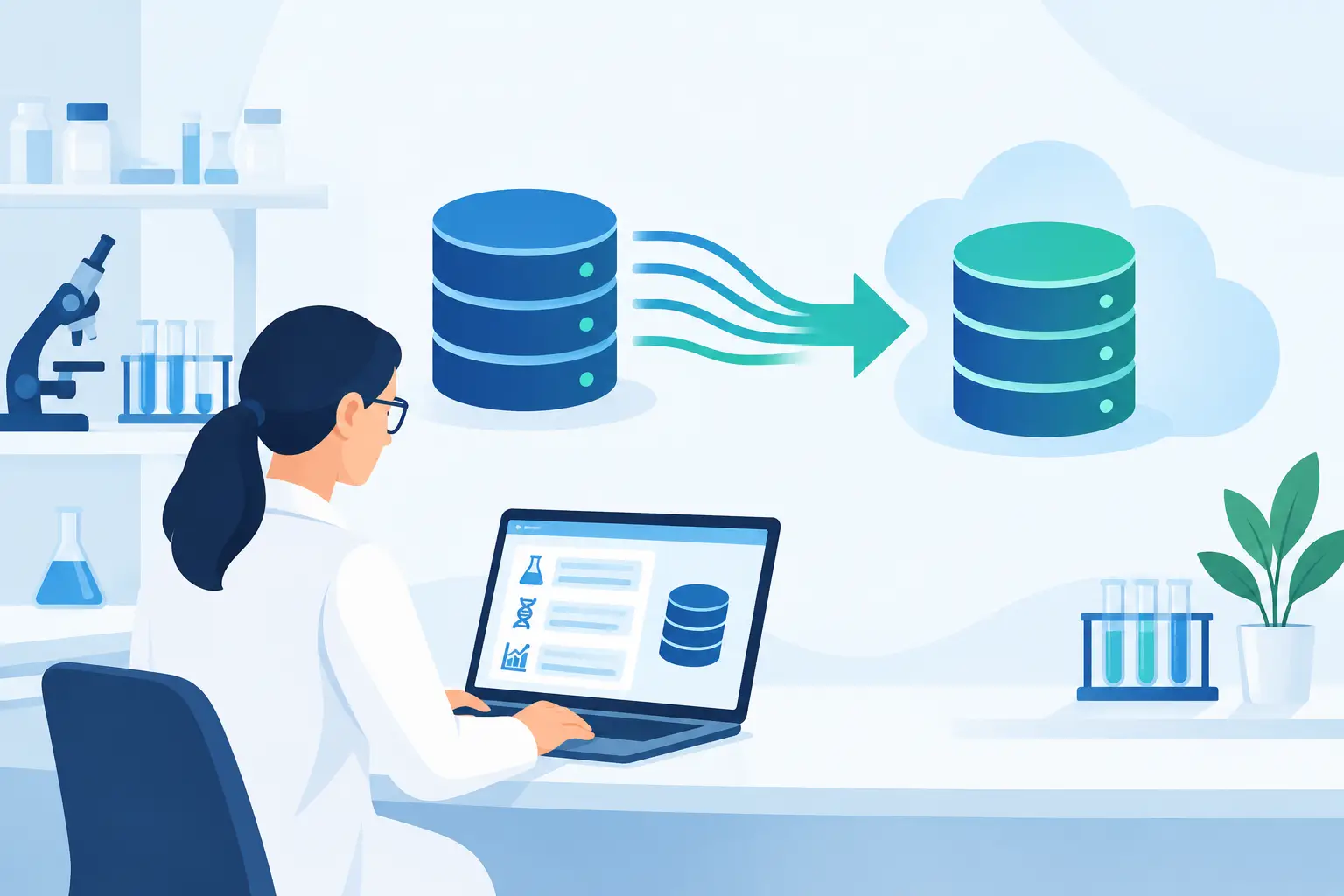
A laboratory data migration is not simply a file transfer. It is a controlled change to the system that establishes sample identity, experimental context, inventory status, instrument records, and compliance evidence. The best laboratory data migration practices treat those relationships as the primary asset. If a sample record arrives without its parent study, storage position, chain of custody, or associated result, the laboratory has moved data without preserving its operational meaning.
This matters when replacing spreadsheets, retiring a legacy LIMS or ELN, consolidating systems after an acquisition, or implementing a broader digital laboratory environment. A well-executed migration gives teams a usable, traceable system of record from day one. A poorly controlled one creates duplicate identifiers, orphaned records, incorrect inventory balances, and long-term uncertainty about what can be trusted.
Start With a Migration Scope That Supports Laboratory Operations
The first decision is not technical. It is determining what information must remain active, searchable, reportable, and auditable in the destination system. Many laboratories initially decide to migrate everything. That approach can be justified for regulated records or long-running studies, but it can also transfer years of obsolete templates, inconsistent nomenclature, duplicate contacts, and incomplete data.
Define the scope according to operational and regulatory need. Active samples, open studies, current reagent lots, equipment maintenance records, active storage locations, and records required for retention should generally receive the highest priority. Older completed work may be archived in a read-only repository if it remains accessible, protected, and retrievable under the laboratory's retention policy.
A useful scope document identifies each source system, data owner, record volume, retention requirement, target module, and disposition. It should also distinguish between data that will be migrated, data that will be transformed, and data that will be archived. This prevents late-stage disagreements when a team discovers that historical attachments, audit trails, or custom fields were assumed to be in scope but were never mapped.
Inventory the Data Before Designing the Import
Laboratory data rarely lives in one place. A LIMS may contain sample accessioning and results, while an ELN holds experimental methods and observations. Freezers may be tracked in spreadsheets, purchasing records may sit in an ERP platform, and instrument output may reside on local drives or vendor software.
Build a source inventory before configuring migration scripts or import templates. For every source, identify the tables or files, formats, identifiers, field definitions, controlled vocabularies, dependencies, attachments, and record counts. Include data quality observations rather than assuming that source values are correct because they are established.
This is where laboratories often uncover the actual complexity of the project. For example, a field labeled “Sample ID” may represent an accession number in one application, a tube barcode in another, and a manually assigned project code in a spreadsheet. Those values cannot be treated as interchangeable. The migration team must define the authoritative identifier and preserve alternate identifiers where they remain operationally useful.
Preserve Relationships, Not Just Individual Records
Scientific and operational records derive value from their links. A result must connect to a sample. A sample may connect to an aliquot, patient or donor record, study, protocol, container, freezer location, and processing event. A reagent must connect to a lot, supplier, expiration date, and the experiments in which it was used.
Create a data model that documents these relationships before extraction begins. The model should show parent-child dependencies and identify the sequence in which data must be loaded. Reference data such as users, projects, sample types, units of measure, storage hierarchies, and controlled vocabulary terms are usually loaded before transactional records.
Avoid replacing meaningful links with plain text during transformation. If a legacy record includes a freezer location, the target system should receive a structured location reference where possible, not merely a note stating “Freezer 2, Rack C.” Structured relationships support barcoding, inventory movements, reporting, permissions, and downstream automation.
Establish Identifier Rules Early
Identifier management deserves its own workstream. Decide whether existing sample IDs, inventory IDs, and experiment numbers will remain unchanged, receive a prefix, or be cross-referenced to new identifiers. Reassigning identifiers may be necessary after a merger or when standardizing sites, but it increases validation and user training demands.
Maintain a crosswalk between legacy and destination identifiers. This crosswalk should be retained as a controlled migration artifact, particularly when historical reports, paper records, external collaborators, or instrument files reference the legacy value. Never allow an import process to silently generate replacement identifiers without preserving the original identifier in a searchable field.
Clean and Standardize Data Before Loading
Migration is a practical opportunity to correct preventable inconsistencies, but it is not the time to reinterpret scientific records. Correct clear errors, standardize formats, remove known duplicates according to approved rules, and normalize controlled values. Do not alter original observations or replace uncertain values with assumptions.
Typical preparation work includes standardizing date formats, units, concentration expressions, specimen types, supplier names, storage labels, and status values. The team should document each transformation rule, including its purpose, source field, target field, and exception handling. A rule such as converting “-80,” “-80C,” and “minus 80” into a controlled freezer temperature value is reasonable. Inferring a missing sample type from a project name generally is not.
Data cleansing should be owned jointly by technical staff and laboratory subject matter experts. Administrators can identify null values and inconsistent patterns, but scientists and quality teams are needed to determine whether a variation is an error, an accepted historical convention, or evidence that a record requires investigation.
Validate in Iterations, Not Only at Go-Live
A migration should be tested as a series of controlled cycles: extract, transform, load, reconcile, correct, and repeat. Early test loads expose mapping gaps while changes remain manageable. Waiting for a single final import concentrates risk at the point when the laboratory is preparing to switch systems.
Validation must extend beyond record counts. Count reconciliation can confirm that 10,000 sample records arrived, but it cannot confirm that each sample retained the correct project, storage position, status, and related result. Define acceptance criteria for completeness, accuracy, relationships, security, and functional use.
A practical validation plan typically includes the following checks:
- Record counts by entity, project, date range, and status
- Required-field completion and controlled-vocabulary compliance
- Referential integrity between samples, aliquots, studies, locations, and results
- Spot checks against source records, including edge cases and attachments
- User acceptance testing for search, reporting, barcode workflows, and permissions
For regulated laboratories, maintain objective evidence of these tests, deviations, corrective actions, and approval decisions. The appropriate validation depth depends on the intended use of the system and applicable requirements, but the governing principle is consistent: the laboratory should be able to demonstrate that migrated information remains fit for use.
Plan Cutover Around Real Laboratory Work
Cutover planning should reflect the laboratory's actual operating rhythm. A migration scheduled during a major sequencing run, clinical reporting period, annual inventory count, or stability study milestone introduces unnecessary operational risk. Select a window that allows for a controlled source-data freeze, final delta extraction, verification, and support coverage.
Not every migration requires a full shutdown. A phased approach can work when modules or sites are relatively independent. For example, a laboratory may migrate inventory and storage management before moving ELN templates and experiment records. The trade-off is temporary coexistence between systems, which requires clear ownership rules and disciplined handling of records created during the transition.
Create a cutover runbook with named owners, timestamps, decision points, rollback criteria, and communication steps. Include procedures for source-system access, final backups, import execution, reconciliation, user provisioning, label printing, instrument connections, and support escalation. The goal is to eliminate ambiguity during the period when staff need fast, reliable direction.
Configure the Destination System Before Moving Production Data
The target environment should reflect approved laboratory workflows before production records are loaded. Configure user roles, project structures, sample types, storage hierarchies, barcode formats, units, controlled fields, templates, and required metadata first. Otherwise, the migration may force source data into temporary structures that later need manual correction.
A configurable platform such as LabCollector can centralize LIMS, ELN, inventory, storage, equipment, and reporting workflows, but configuration decisions still require governance. Agree on who can create new sample types, edit controlled lists, modify templates, and approve workflow changes. Migration is often the point where laboratories replace informal local conventions with shared operational standards.
Retain Evidence and Support Users After Launch
The migration package should include the approved scope, source inventory, mappings, transformation rules, test results, reconciliation reports, exception log, approvals, and final data extracts. These materials provide traceability for audits, investigations, and future system changes.
After launch, monitor the issues that affect daily work: failed barcode scans, missing searches, permission conflicts, unexpected location behavior, report discrepancies, and records that were active in the source but omitted from the final delta load. Provide a defined support channel and a short period of heightened review. Users who report problems early are helping protect the new system of record.
The best outcome is not a migration that merely finishes on time. It is a laboratory environment where staff can trust the identity, context, and history of every record they need to use next.
See LabCollector on Your Own Workflows
LIMS, ELN, test management, storage and instrument integration on one platform — start free, or have us walk you through it.
Learn more: LabCollector LIMS · Electronic Lab Notebook · Contact · About
 English
 French
 Spanish
 Portuguese
 Italian
 Polish
 German
 Dutch
 Danish
 Swedish
 Greek
 Norwegian
 Finnish
 Romanian
 Hungarian
 Czech
 Slovak
 Hebrew
 Arabic
 Japanese
 Korean
 Ukrainian
 Latvian
 Turkish
 Croatian
 Chinese (Simplified)
 Bulgarian